

What abstract painting and the unconscious taught me about action, receptivity and relinquishing predetermined meaning
Over the last year, I have been learning how to paint. Occasionally during the process of making a painting, I have had the experience that I can only describe as ‘something else at work’. I am not talking about magical thinking but rather about allowing something beyond my conscious control to happen through the work.
I paint in cold wax and oil: a medium that demands we give up control, refusing to consent to be held by a brush. Rather, it insists on being applied with an old credit card, a palette knife or even bubble wrap. It is the perfect muse for abstract painting.
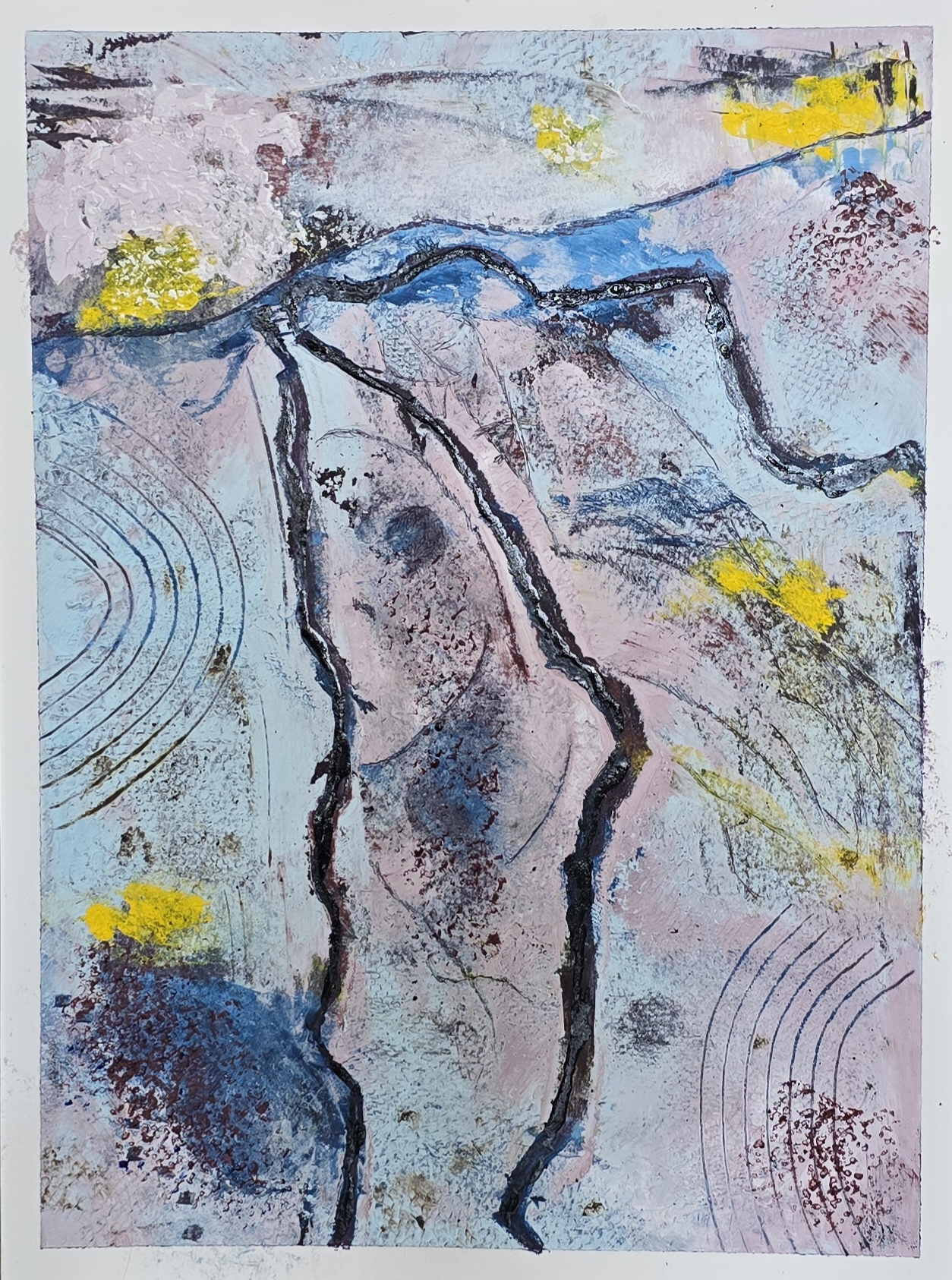
In a recent abstract piece, I began by mixing a deliciously rich dark purple, spreading it onto the canvas with a bowl scraper. When it was dry, I felt like I didn’t want to disturb its depth but bravely applied some jagged slashes of electric blue and yellow, allowing the pigments and wax to mix directly on the canvas as I applied them. I used bubble wrap to apply some highlights in a mix of light Indian red pigment. The energetic movement of my body as I made the marks seemed to come alive on the canvas. As I stood back and looked at the artwork, it spoke to me (perhaps rather too quickly) of defences and the parts of ourselves that lie buried behind false scaffolding. I liked that the marks seemed to have a life of their own, like fronds of wayward weeds in a fast-flowing river caught dancing in beams of sunlight.
When I came to look at it the next day, it seemed garish. I wanted to cover it over, quieten it down. Suddenly its energy seemed embarrassing. So, I mixed an opaque layer of a pale, chalky mauve pigment, and – almost gleefully – spread it across the entire canvas to conceal everything below it. Suddenly I felt blinded. So whilst that layer was still wet, I scraped three deep cracks, like fissures that ran from a central spot on the left and extended right across the horizontal orientation of the piece, revealing the dark purple and flashes of colour below.
Then I stood back and took in the image and felt hate and disgust. Real, visceral emotion that I felt scuttling down my arms, tingling with an impulse to grab the canvas and throw it in the bin. I had to work hard to resist this. So, I turned it to face the wall and let it dry for five days, casting it entirely out of my mind. When I returned to it, the fissures seemed more pleasing, and I ran slate grey oil liquid oil paint into them to create more depth. It began to feel like the painting was giving me a glimpse of what lay obscured inside it. I used a scraper to disturb the top layer and reveal more texture and traces of what was buried: some of the blues and yellows began to show shyly through. I left this for a few more days, no longer feeling the urge to throw it away.
Then when I came to it again, I turned it 90 degrees clockwise so that the three dark fissures ran down the vertical canvas from a horizon point. I took in the textures, colours, dancing light and deep fissures and felt seduced; I pulled up my chair and gazed at it for a while. That’s when I saw her peeking nervously at me from between the cracks. A small child, hidden and full of vulnerability, watching me through the cracks. I fell in love with that painting then.
I found myself astounded at this process: that what had been so hatefully received now filled me with love and awe. I thought about the psychoanalyst Donald Meltzer, who, interestingly, had a conception of psychoanalysis as art. Meltzer and Williams’s account suggests that the aesthetic experience of encountering beauty in the world has an impact on the mind that is at once violent and tender. (Meltzer and Williams, The Apprehension of Beauty: The Role of Aesthetic Conflict in Development, Art and Violence, 2018).
This object, whose depth I could not anticipate, provoked a strong response in me – that initially felt like hate at first sight, and on its heels came a similarly strong feeling of love at first sight. If I hadn’t been able to tolerate the hateful and violent reaction – wanting to throw the painting in the bin – I would have missed out on this experience of reciprocity and awe. I was not just a detached creator – in fact, I wasn’t really in control, consciously, of its creation. But neither was I a passive viewer.
I realised that it was only by allowing the painting to impact me, and affect my subsequent action on it, that the child could emerge. I had not put her there, consciously, yet there she was. Perhaps she had been in my unconscious all along even as I was thinking about defences and suchlike?
At various points I felt compelled to act – to conceal the electric colours, to scrape back the blindly concealing veil, to turn the painting to a vertical orientation. Responding to this without knowing why helped me to avoid any predetermined meaning and allowed the work to reveal something to me that was new. Despite my resistance, I was prepared to be surprised. I was aware of and curious enough about my hate not to act violently on it – throwing the painting away – and I was rewarded with love.
It seemed, just for a moment, that I was not the doer of the work; rather, I was in dialogue with something that was working through me.